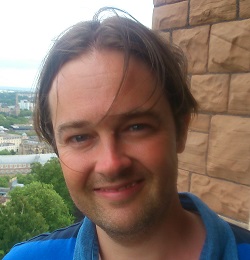
I obtained a first class Honours degree in physics from the Open University in 2013.
I completed a Masters degree in Cognitive and Computational Neuroscience at the University of Sheffield in September of 2016. My result is currently pending. It wasn't easy but I think I did ok!
I read pure and applied mathematics and mathematical modelling at levels 1 and 2 and at level 3 studied electromagnetism, general relativity and quantum theory.
My dissertation was on entanglement in quantum mechanics. Quantum entanglement occurs between certain pairs of particles (e.g. a photon or an electron). These two entities may be described by a single mathematical object known as a wave function which determines the probabilites associated with measurement (momentum, position etc.). A physical measurement of one particle in a pair collapses or changes this probability wave and effectively changes the set of possible outcomes of the sister particle. Thus the second particle has a set of observables (possible properties) that is determined by the initial measurement of the first particle. The distance between the two particles does not limit this effect. At the very instant one particle is measured the state ot the second particle is changed regardless of the distance between them.
I researched a topic known as 'Entanglement Swapping'. This is closely related to the topic of quantum teleportation whereby the state or wave function of one particle can be 'teleported' to another across theoretically vast distances. The second particle is initially entangled with another particle (particle 3). By causing the first and second particles to interact in a certain way (known as a Bell State Measurement or BSM), the state of particle 1 is transferred to particle 3.
Entanglement swapping is very similar except that there are two pairs of entangled particles. When one particle from each pair interact in a BSM they become entangled with each other. So too do the other two particles (i.e. they become entangled with each other). Thus the two entanglements (initially between 'particles' 1-2 and 3-4) interchange leaving entanglements between 2-3 and 1-4. What is mindbendingly amazing is that one can decide to perform the BSM even after the other pair of particles has been measured (i.e. they have been destroyed). Then, depending on the outcome of the BSM, the measured properties of these 'ex-particles' still demonstrate this transfer of entangled states whenever the BSM is performed, yet if one decides to not perform the BSM the entanglement is absent.
BSc dissertationNot content with just researching subatomic processes and the structure of space and time I turned my attention to the study of the mind. My Masters degree covered a wide field in neuroscience from neural biology to cognitive psychology, and from neural imaging to computational modelling.
For my dissertation I developed what may well be the first ever computer simulation of the basal ganglia to incorporate a newly observed pathway between the external segment of the globus pallidus to the striatum. The basal ganglia are a group of deeply lying structures involved in the selection of actions. I investigated the role of this pallidostriatal pathway and proposed that each of its elements plays a role in refining the process of action selection.
My model was created using the mathematical visualisation and programming package MATLAB.
MSc dissertationI am highly numerate and computationally literate. I studied applied statistics at undergraduate level 3 where I learned the fundamental statistical concepts and their application and gained experience with the statistics software Genstat.
In both my degrees and personal research I have experience understanding and applying probability distributions, linear regression models such as ANOVA and generalised models (GLMs), and Bayesian analysis and inference.